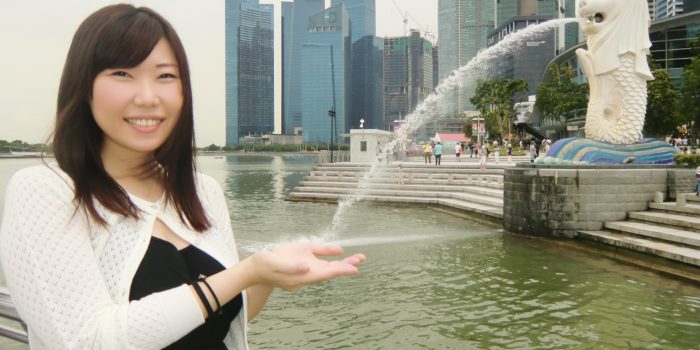
Minami’s Case (From Tokyo to Jakarta, unpaid leave in the media industry)
Due to her working situation in the media industry, Minami has lived in many different cities in Japan. Last April, she moved with her son from Tokyo to Jakarta, where her husband has been living for the last couple of years. Minami herself now plans to go back to Tokyo after 1 year, although there is still a possibility of extending her life in the city.
Profile
Name: Minami Age: Early 30’s
Minami was born in Ishikawa Prefecture in Japan. While in university studying foreign languages, she spent 1 year in Singapore as an exchange student. After graduation, she worked in several media companies, which led her to live in various cities throughout Japan. She has been on a leave since April 2017 and has moved to Jakarta. There she now lives with her husband and son who is in elementary school.
Reason to have moved to Jakarta
———- Seeing your relocating history, you are like a nomad.
Minami: That’s true. I have been moving like this only because of my job, so I am not really self-motivated about it though. I knew that I would go through relocations often when I started to work, so I have no problem with it.
———-Did you choose your job including this kind of lifestyle?
Minami: Definitely.
———What was the reason to move to Jakarta?
Minami: My husband has been in Jakarta since last year. I joined him with our son taking a leave from my job for a year. In my company, there is a system that allows employees to take a leave when their spouses work as expats. You can take 1 year at a time, up to the maximum of 2 years. For now I plan to take 1 year, but still haven’t fully decided yet.
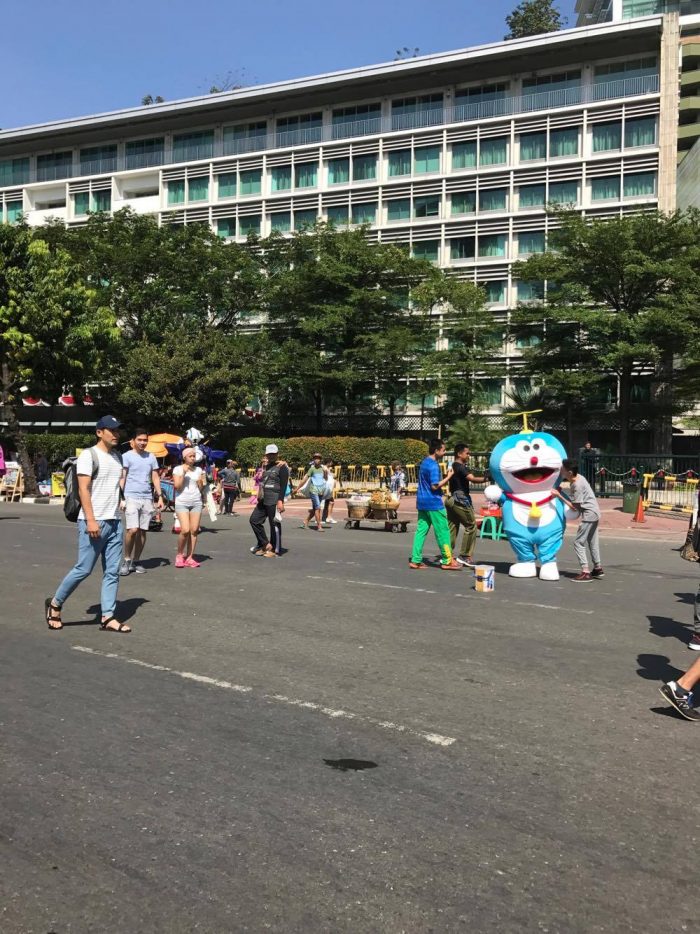
Jakarta is famous for its heavy traffic. It was a car free day on Sunday in the city central. Full body suit of Doraemon(?) does business to take pictures with tourists then ask for money.
———Is it different to you, moving domestically and internationally?
Minami: Initially I thought it would be different, but it might not be that different. It is the same in the sense that you are separated from what you are familiar with. Just that difference of the sense of value in a new environment is bigger when it is abroad.
I am seeing my child closely for the very first time
———How has your life changed after moving there?
Minami: My life cycle has been very much changed. I feel that now I am seeing my child closely for the very first time. In Japan I could not stay at home much because of my job. That means that now I can see no-so-good things about him as well, hahaha. But of course so many of the good things too. Discovering what makes him laugh, what makes him happy, it is very eye opening. Spending more time with my family was one of the reasons I moved here.
Another thing is building a relationship with other moms. This is a new thing for me to spend a good amount of time with them, only in the Japanese community though.
Expectation
——–What did you expect life in Jakarta would be like?
Minami: I was not really familiar with the culture of Indonesia before, so I was looking forward to studying the language and so on. Learning to speak a new language all over again and communicate with it, plus having myself surrounded by different values. I was interested in their religion and culture as well. In fact it has been a lot of fun experiencing them all.
———How is the language situation in Indonesia?
Minami: Official language is Indonesian. They don’t speak much English. So you could say that it is necessary to learn the language to live there. When I shop in markets, I make the most of my limited Indonesian like ”How much is it?” and “Can I use a credit card?”
Never been treated like a foreigner
——–How does it feel to be in Jakarta as a foreigner? Do they treat you somewhat differently?
Minami: Not at all! Japanese tend to be thought of as rich, so depending on the situation there may be some people who would try to sell something to you.
Other than that, they come to you and speak to you in Indonesian in their regular speed, like nothing special. It doesn’t matter to them if you are Japanese. They don’t get shy around foreigners. They just come to you and burst into conversation so naturally.
——– How do you react to them in those situations?
Minami: I answer to them when I understand what they are saying. When I don’t, I say to them straightforward “I don’t understand what you are saying”. After that, some try to talk in their limited English, others say “Then that’s alright” and leave. What I try to keep in mind at all times is to listen to them even if I don’t understand them. I would not say no to conversing with them.
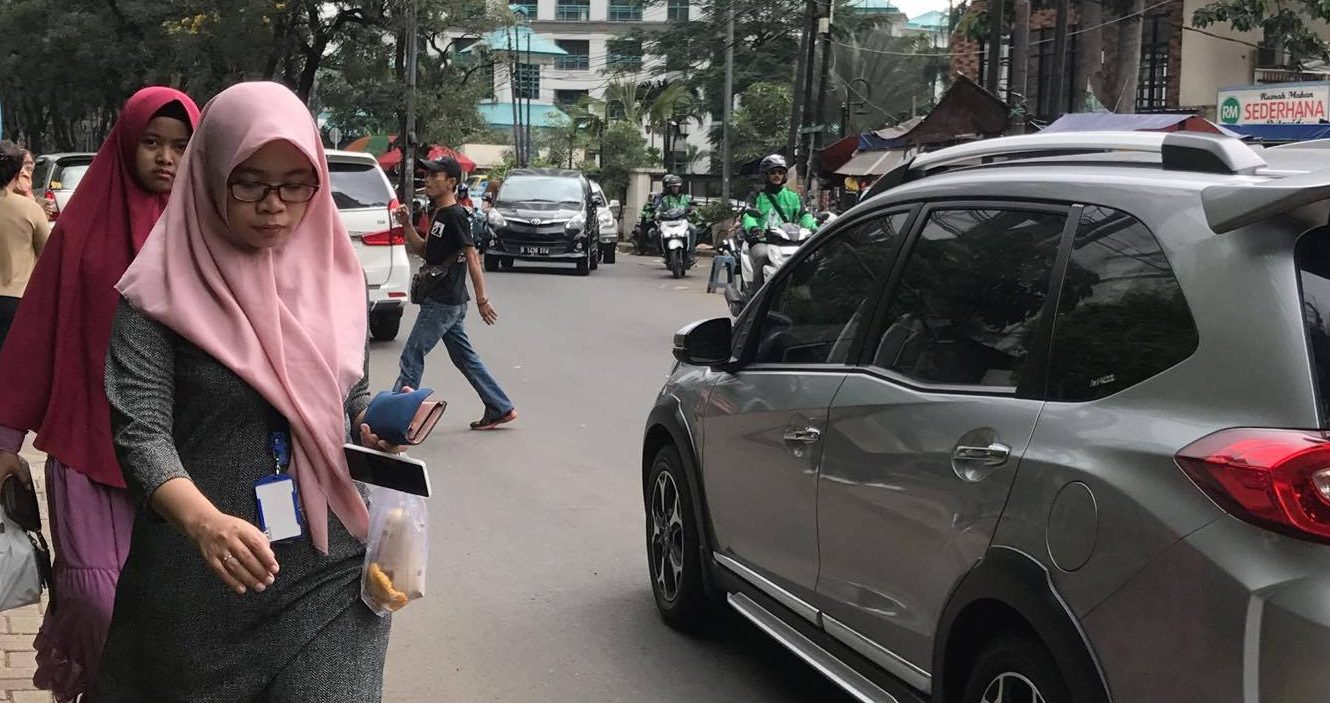
Central area of Jakarta
Concerns about living abroad
———Did you have any concern before moving to Jakarta?
Minami: Yes, about the hygiene and childcare environment. Especially about the medical field and food.
———-What sort of research did you do in advance?
Minami: First I met someone who once lived in Jakarta. I asked her mainly about medical care and vaccinations, since there are infectious diseases such as hepatitis A and hydrophobia.
Also I referred to a website that has various information for expats. In Japan, I prepared things that can only be prepared in Japan, such as a water purifier and medicines. The rest I decided to prepare in Jakarta.
Since here in Jakarta the hygiene environment is not as good as in Japan, I hear many people say that they need to do all the vaccinations in Japan. I had some in Jakarta, the ones that are available in the city.

———-What would be the bright side of getting vaccinations in Jakarta?
Minami: Here, one type of vaccination can be completed with just one visit whereas it often takes a few times in Japan. Also you can find hospitals nearby that have vaccinations. When it comes to hydrophobia, hospitals that provide it in Japan are very limited and you need to go there just to have it. Whereas in Jakarta, regular hospitals have vaccinations for hydrophobia, typhus and so on. Last but not least, prices are more reasonable than in Japan.
Raising a child abroad
———-Did you have any concern about raising you child in Jakarta?
Minami: I had no idea how safe local food is in terms of the use of pesticides and the agricultural environment. I was not sure if it was all right to give my kid the food I buy at the supermarket here.
Also I heard before I came here that it is not an environment that you can freely let your kids play outside because of the massive traffic, pollution and not-so-great public safety. That was a concern, knowing that the places he could play outside would be limited, that he may not be able to work out his body to grow healthy.
———Now what do you think of these challenges?
Minami: They all turned out to be okay, though not perfect. You can buy organic food, just that they are more expensive. It costs more, but as long as you pay for it, safe medical care and food are available. Just the price is high.
More relaxing and stress free
———-Have you noticed any change about yourself after the relocation?
Minami: I guess I have become more easygoing. Firstly, about time. In Japan I don’t have enough time for everything, besides things come and go so quickly, which made me feel tense all the time. While after coming here, I guess I have become more laid back, rather less punctual. Ahaha. Besides here in Jakarta, people are so relaxed and kind to people with kids even when they make noise. You know in public areas in Japan, people could look so coldly at them in that situation. That sort of easy openness, I think I have been affected by it.
Also when I think of something as a problem, people here would say, “ It’s okay, okay”. That let me be more relaxed about things in general. I find it more stress free that way, and people can live without problems that way.
Reassessing Japanese sense of value
Minami: Having said that, I also got the appreciation to have grown up in Japan after coming here.
———For example?
Minami: Hmm how can I put it, it feels a bit difficult to explain it. For example, the sense that you take good care of what you have. Or that you can taste the sensitive flavor of things such as Dashi(Japanese soup stock). Things like that, at different levels and aspects. Japanese sense of value used to be my complex actually. Like, you could care about details a little too much, or that you could be a bit too squared. These same things though have good aspects, you attend to details to not make other people feel annoyed, you are diligent to learn and acquire new things. I have realized those good qualities.
Even here, there are time that I find the table Japanese people finished meals, and dishes are piled neatly so it would be easier to take care of . Then I find myself thinking like ”Oh this is nice. I like this sort of thing”.
————At the same time, you like the easygoingness and the atmosphere of Jakarta, which is different from Japan, right?
Minami: That’s right. I guess I have become able to affirm diversity. I have become able to see things from a higher perspective. It is good that I am Japanese, whereas the sense of value here is also good. I might have become more tolerant. That is a gaining.
Japanese community in Jakarta
————What is the Japanese community in Jakarta like?
Minami: Some live only inside the community, others stay in touch in moderation. It depends on an individual how to deal with it.
You can totally live only inside the community, if that’s what you want. There are company residences and some companies have only Japanese workers. Your kids can go to the same school and you can go to the same grocery stores. If you don’t get outside of the community, it is easier and it can secure some stability. There are many people who spend their lives that way. I myself think that I would like to keep those sorts of relationships in moderation and communicate more with the local people because I am here.
Building relationships in the current location
———– Have you got new friends here?
Minami: No, no. That is my goal for the rest of my time here, building my own community. That’s why I am going to university from September.
———–That’s awesome!
Minami: Yeah, I thought that if I didn’t do anything, I would not be able to meet anyone other than Japanese, and it would be a shame. So I am going to take Indonesian language courses for foreign students in university. The teachers are local; also there may be chances to communicate with students who study Japanese there.
I am not sure yet how much communication and interaction there is going to be, but I thought that first I would get out of this current fixed community I live in. Initially when I came here, I was feeling so lonely and I could not do much other than taking care of it, but I guess I am more relaxed and ready now.
————Are there any challenges or difficulties that you are facing?
Minami: It is exactly the thing I was talking about. Building new relationships here, not only with the Japanese community, but also with local people. I am always thinking about what sort of relationships with people and what kind of balance would be good and comfortable for me.
————What do you miss the most about back home?
Minami: It’s people. Not much about other things. Things other than people, I can adapt myself to.
Relocation is a change. Doesn’t make me feel it costs something else
————When you relocate yourself, I assume that there are things that you have to give up instead. How do you make that choice in priorities?
Minami: When I move, it doesn’t make me feel like I choose something over another. I perceive it as a change rather than a choice. Even when you keep living in the same place, there will be changes all the time right? There is nothing that doesn’t change, from my values to my child’s growing up.
So the fact that relocation changes relationships with people, your career plan and so on, I perceive it as one of the changes to make things better. If things stay the same, it is not fun nor can you grow.
To find what makes you comfortable
————It sounds like relocation is something natural to you.
Minami: That is not entirely true, haha. The results of the changes, you have to assess them for yourself, which gives me a tough time sometimes. It does not always go as I wish; there are many headaches too.
———–What was the most difficult thing so far?
Minami: It has been tough to find something that makes you feel comfortable all over again, now that I am away from my job and the people I know. It could be anything that you feel comfortable about, your life style or the material stuff around you. I feel like everyone is looking to be comfortable.
———–Would you consider moving to another place?
Minami: Yeah I would definitely! It is fun. You eat new food and talk to different people, and feel like “There are people like this”. That’s definitely fun. If I get a chance, I would like to live in some Western countries. Or maybe a Chinese-speaking area would be good too!
Illustration by Kaori Oishi