Helen’s case (From Sichuan, Tianjin to Tokyo/Web Designer)
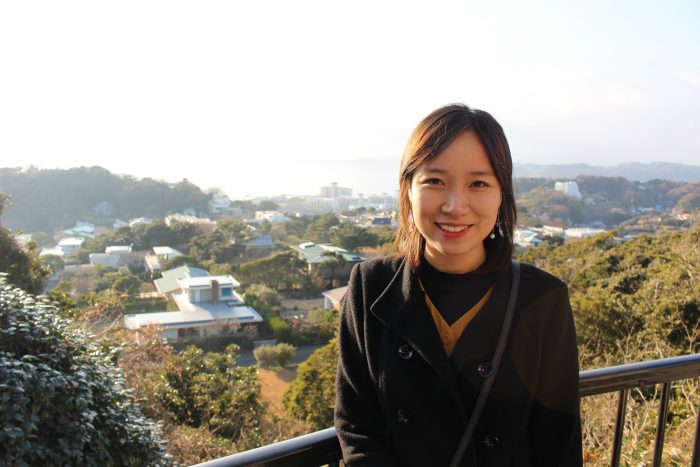
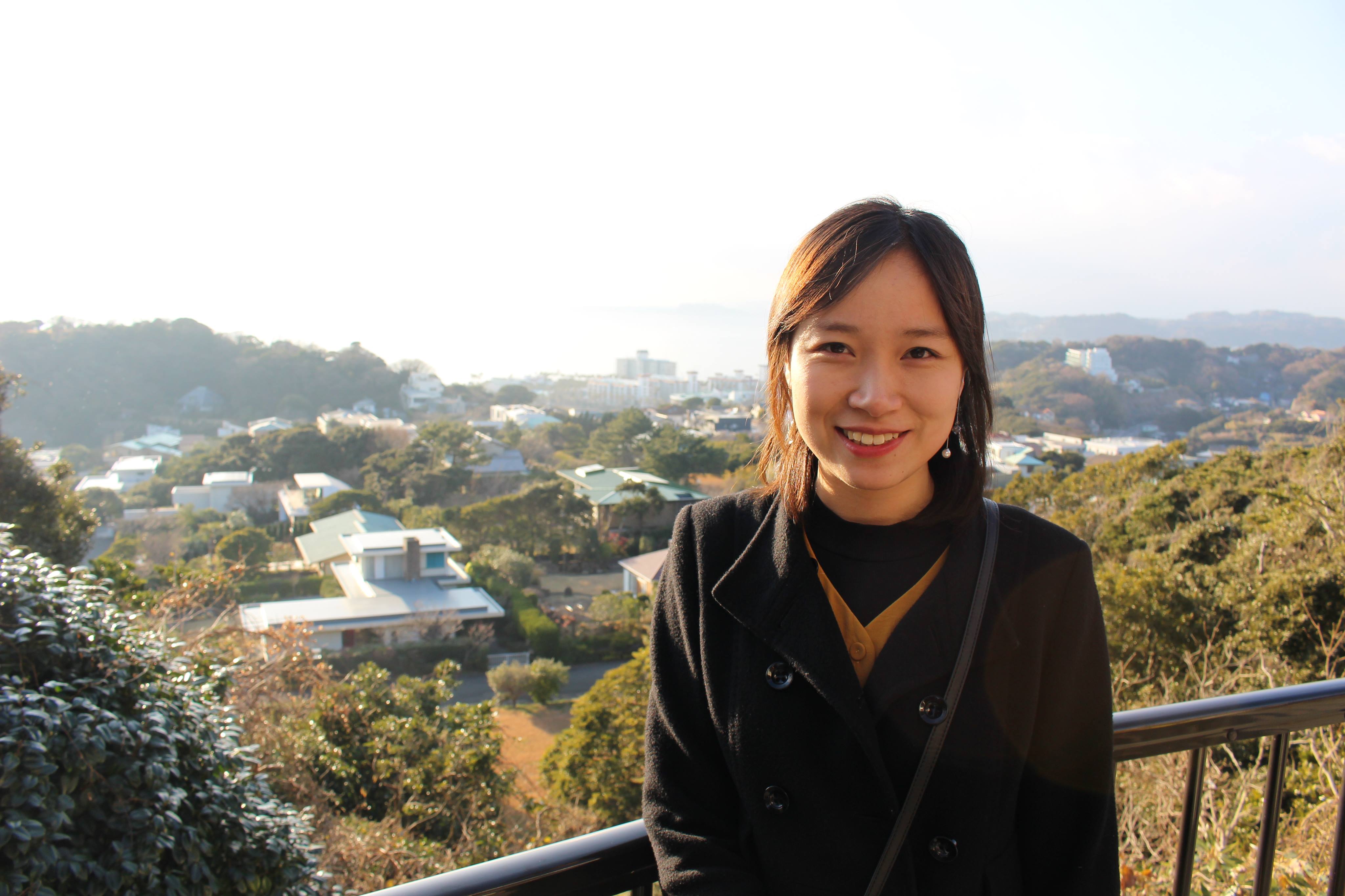
Helen moved to Tokyo from Tianjin in 2015, to go to graduate school to study design. She now works as a web designer in Tokyo. As the interview went on, topics related to Japanese rules and manners were often brought up. Her realizations cover various aspects from make-up and clothes to the workplace and washroom.
Profile
Name: Helen Age: 25
Helen was born and brought up in Sichuan, China. She entered University in Tianjin, and spent 4 months studying in Spain during that time. After graduating from University, she moved to Japan and entered graduate school at Keio University in April 2015. She received her Master’s degree in 2017, and then started to work in a design company in Tokyo.
Background of moving to Japan
—————You are from Sichuan; what is the city like?
Helen: In China, the image people have for Sichuan is relaxing and not very serious [laughs]. Like, people are always making jokes or laughing. Also, Sichuanese people walk a bit slowly, whereas in other big cities, people walk fast because they are busy. When I lived in Tianjin, it was hard keeping up with others while walking, like “Wait for me!” [Laughs]
—————You went to University in Tianjin right?
Helen: Right. I majored in English in University. Tianjin is located in the north of China, close to Beijing, about 30 minutes away. The image that I have for the people of northern China is more or less strong. Whereas down South such as Sichuan, people are a bit slower and kind.
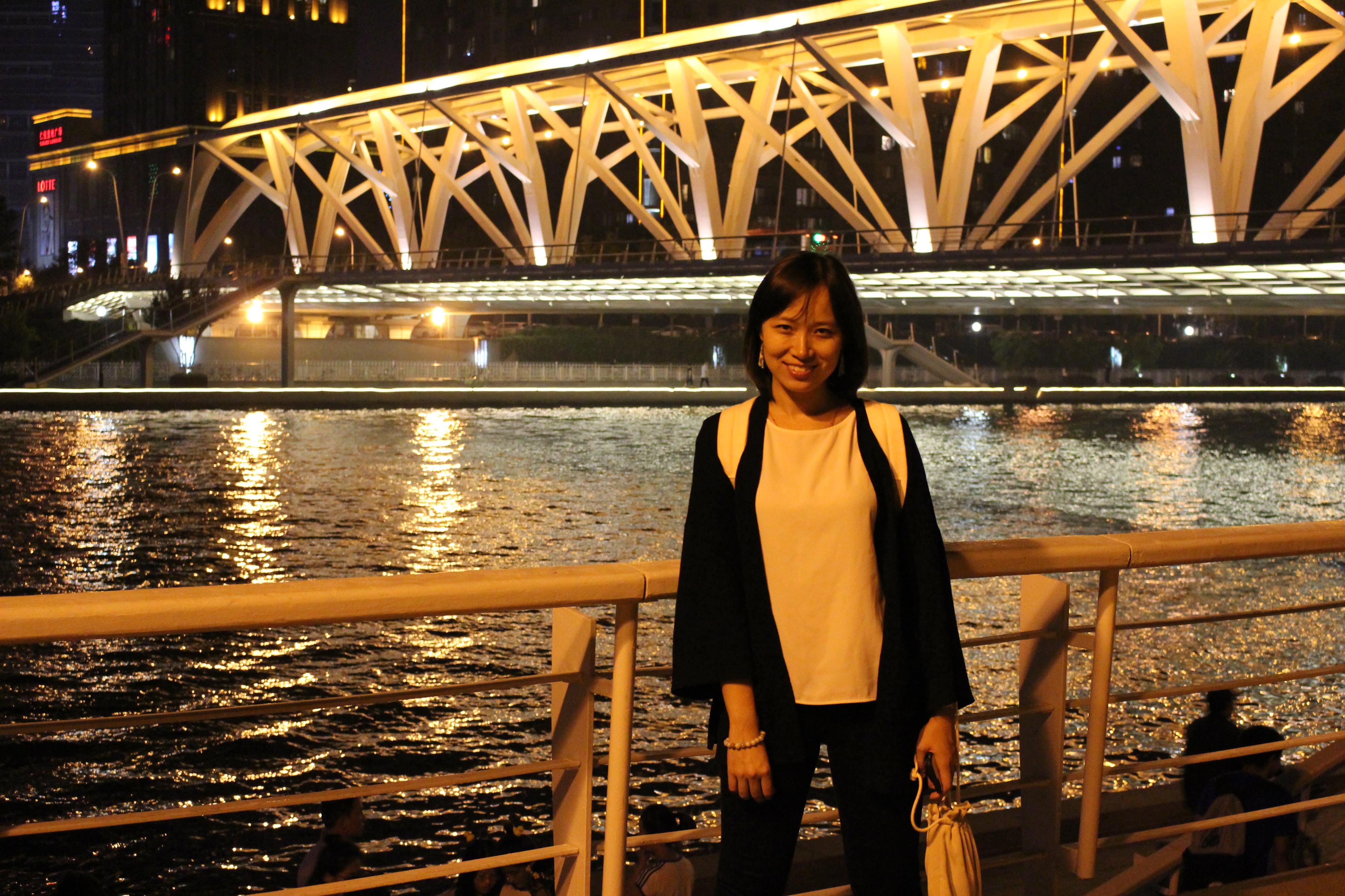
In Tianjin
—————What made you decide to go to graduate school in Japan?
Helen: I always had this interest in arts and design. I loved Japanese design, as it is beautiful and filled with imagination. Then I found this course for design in a graduate school in Japan, I thought I wanted to try it.
My parents always wanted me to become an interpreter. That is why I had studied English. Though before trying to work as an interpreter, I thought I wanted to study something that I was truly interested in. If that would change my path in future, I thought that would be good too.
Even if I couldn’t eventually work in design, if I studied in Japan, I thought I would be able to speak Japanese, which I thought would expand my prospect as an interpreter. Also in China nowadays, many young people can speak English, so I thought only English would not be enough.
—————It is great that now you have a job in design.
Helen: Yeah, it actually changed my path.
—————Did you study Japanese before coming to Japan?
Helen: No. Then at graduate school, there were not many classes that used Japanese actually. Just like 4 hours a week. After I started to work, I use Japanese everyday at the office so I may have become a bit better at it by now.
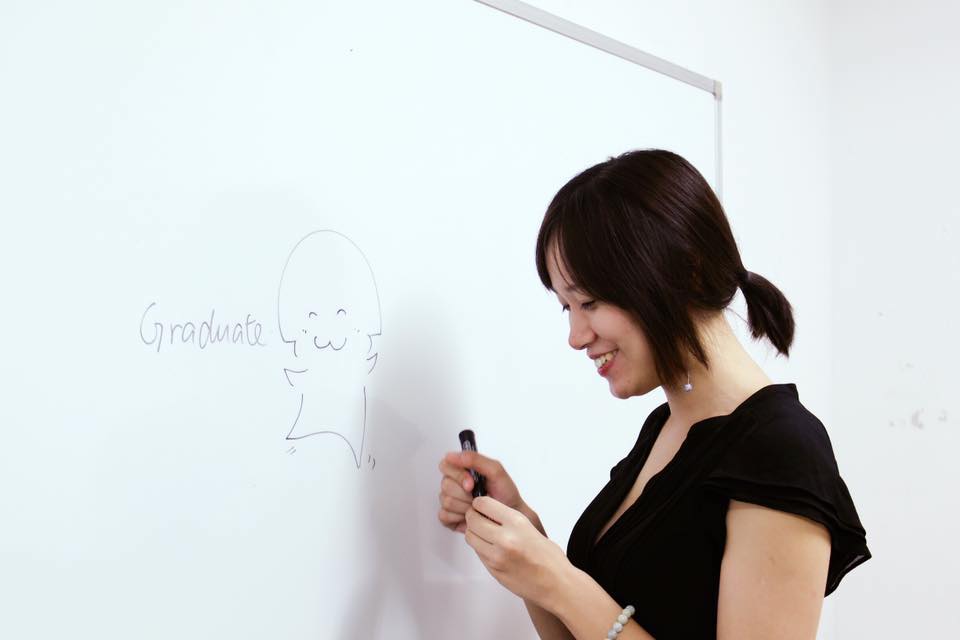
At the university
Expectation for life in Japan
—————Did you have any expectations before you came to Japan?
Helen: Yeah sure, there is a plenty. Food to start with [laugh]! In China there are many Japanese restaurants and I loved Japanese food, such as Sushi and Ramen. I could not wait to have real Japanese food over here.
Also I had this big expectation for the city itself. Starting from the city design and how signs are presented, I imagined it would be very user-friendly.
—————What did you think after you came here?
Helen: Food is good exactly as I imagined. I gained weight after moving here, just a little bit. Though it is okay as the food tastes good [laugh]. Also I found it very interesting that people eat Ramen, dumplings and rice at the same time. People never do that in China [laugh].
After I came here and see how things are, I came to really like the city itself. Though there are some things that are different from what I imagined. It felt a bit older than I thought. For instance, there are many stations that don’t have any walls on platforms. I think I found it that way because infrastructures were built in Japan before China.
Concerns for coming to Japan
—————Did you have any concerns before coming to Japan?
Helen: First of all, the Japanese language, as I could not speak it at all, it was a difficulty. Using English didn’t work in Japan as much as I thought it would. So, from city halls to shopping, I needed to use Japanese and it was challenging in the beginning. These days I can work it out most of the time.
—————Among people from abroad I know, there is a certain number of them who said like “ In Tokyo, it is okay to only speak in English.”
Helen: I am guessing that they may look Western? I am Asian, and I got this impression that if I spoke in English, people would wonder like “You are Asian, why use English?” I feel like everyone expects me to speak in Japanese.
In the former interview article, Marcel was talking about “playing the Gaijin(foreigner) card”. Asians can’t play the Gaijin card. Like they think, “You are not so Gaijin”[laughs].
It’s interesting. I think this is good for me though, as it challenges me.
As an individual, not as a stereotype
—————Were there any other concerns?
Helen: Not just about the language, but culturally as well, I was a bit worried if I could communicate well. There is this stereotype of Japanese that “ People don’t say what they think” or “People are punctilious”, so I was not sure if I could act as I did in China. People overlook the details more or less in China.
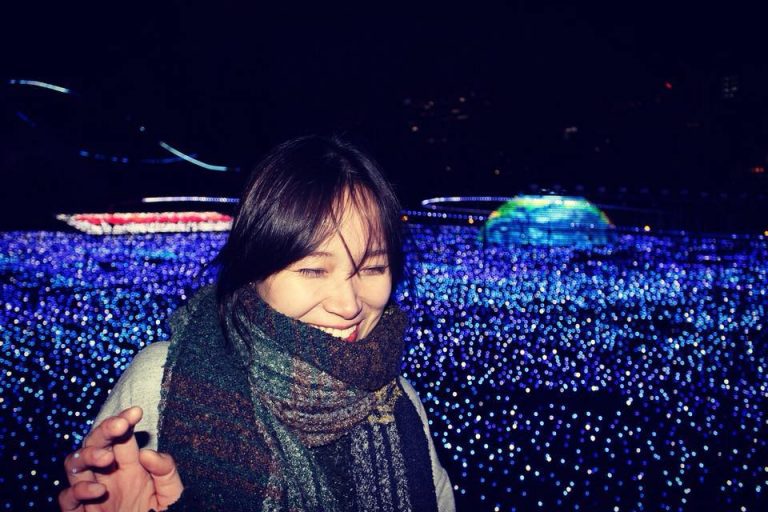
Illimination in Tokyo
—————How has it actually been? Have you changed your communication style somehow?
Helen: My communication style has not changed, nothing changed after all. At the end of the day, I came to realize that when I become friends with someone, it depends on the personality of the individual. It is not about if the person is Japanese or Chinese. When you talk with someone for real, what you focus on is what the person is like, such as his/her personality, experience, or humor.
I found myself not really minding those stereotypes when I actually communicate. Also I believe the people I met in Japan didn’t judge by stereotypes either, but communicate as an individual. For example, I had this concern that people may not like me because I was Chinese. But that was not true at all.
—————You had those concerns?
Helen: Yeah, a bit. In Japan, press about China is not very good, and it is known in China. So I worried a bit. Though that is just a part of the general image, not the image of an individual. That is the same in China. There is sometimes press about Japan that is not good. Though what I believe is that, when you meet someone, it is important to see the person as he/she is, not the country he/she is from.
Rules and manners in Japan
—————What were the challenges you had after moving to Japan?
Helen: What surprised me was that every woman wears make up. I lived in China till I was 23 years old and never really did any make up. It feels like it is a rule to wear make up in Japan. Like, even when you go to a supermarket nearby, you have to do it. If not, then you have to wear a mask. It is not like that in China at all, it’s been tough to get used to it for me. Why do women all wear make up?
—————Hmm. There are some who don’t though. Saying that, there exists this specific make up for job-hunting and such, so I guess it is considered as a part of having manners. I do enjoy wearing make up, but there is definitely a part of me that thinks, “I have to do it.”
Helen: In Japan, people care so much about their own image, like their faces and clothes, it appears to be a bit uneasy. In schools they have uniforms from shoes to socks, and there is a specific type of suits for job hunting. This seems tough.
Also what I found interesting was that, there is this rule in my current company that you have to fold the toilet paper into triangle.
—————Is that a rule [laughs]!
Helen: Yeah, you must definitely fold it into triangle [laughs]. Also, in China if your working hour starts from 9am, it is okay to turn up at 5 past 9. Though in Japan, you have to be there by 8:45. It is not easy, really.
Though I think if you acquire this strict way of being, you hardly get into trouble when you are abroad, because you can behave in a certain discipline for yourself. So I think that is a good thing.
—————It would be good if people from Japan understand and accept how things are locally, keeping their own manner. If people go abroad expecting things are the same, I think it would definitely not work.
Helen: Do you feel you are freer when you go abroad?
————— Maybe a little bit. As I grew up here, I guess the idea that is “It is important to be well mannered” has become a part of me, though sometimes it feels difficult.
Helen: Whereas foreigners think that they have to attend to the details when they come to Japan. That’s interesting. Though it is okay to not care about it too much, don’t you think?
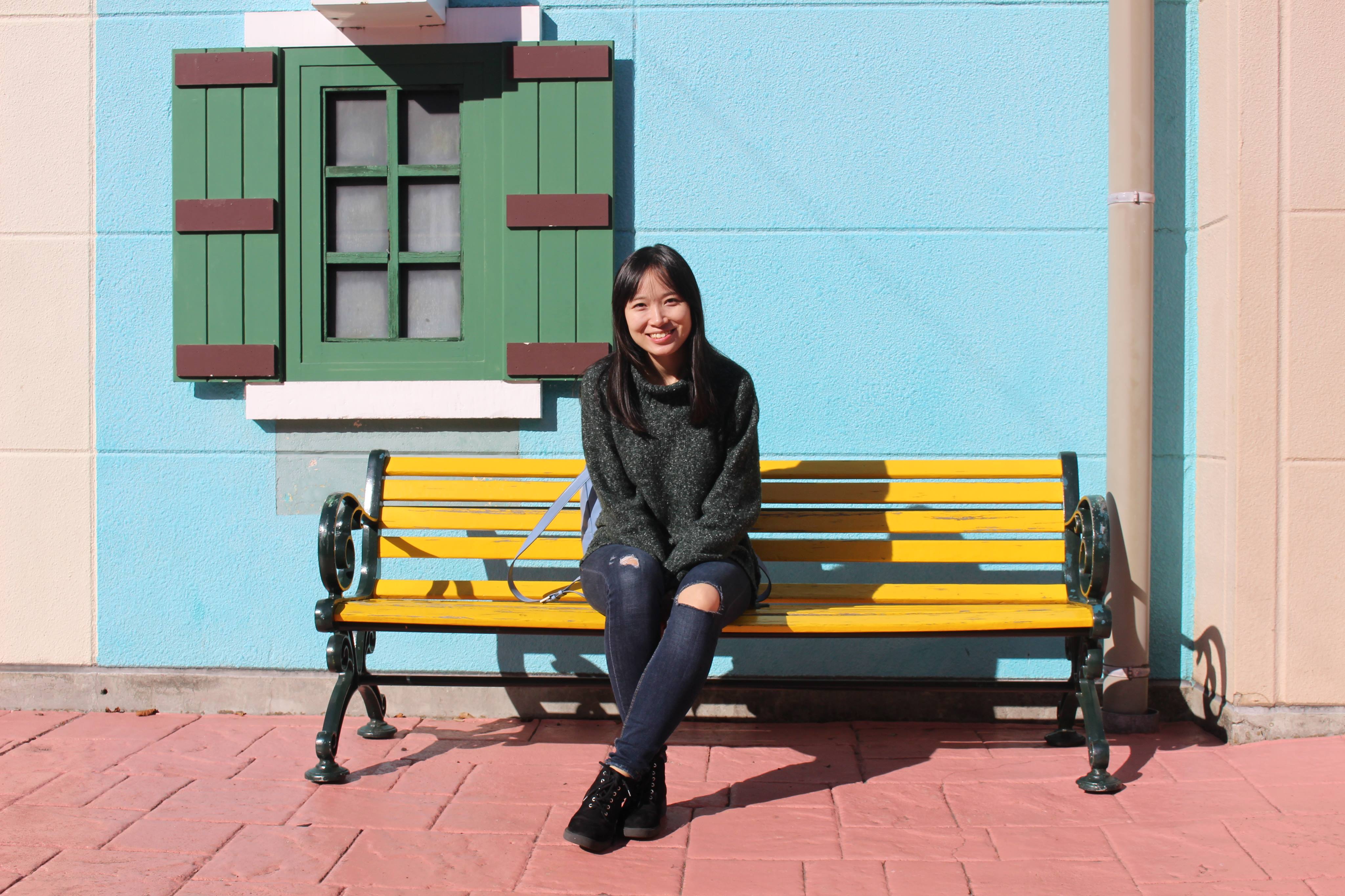
At one of Helen’s favorite spots in Tokyo
It has been 2 years in Tokyo, but I haven’t…
—————Were there any other challenges you have had in Japan?
Helen: To have self-discipline, I guess. When I came to Japan, I was a student at graduate school, living on my own. My parents were not there to tell me to study, sometimes I slept too much, or I cooked too much food and ended up eating it all. Self-discipline was such a challenge.
—————I guess this challenge is more about living on your own, rather than because of Japan [laughs].
Helen: That’s right [laughs].
—————Was that your first time living by yourself?
Helen: When I studied in Spain for 4 months, I lived at a share house and I had my own room. So I felt like I was living on my own, just half way. That time too, self-discipline was a bit of a challenge [laughs]. In Tianjin, I lived in a dorm at University. So when I saw friends around me studying, it helped me to have motivation to study. So I didn’t have any problems at that time.

In Barcelona
Helen: When I was in Spain, I made a to-do list and also came up with a list of the places I wanted to go. But I could not actually do it because of my lack of discipline. I lived in a place about 15 minutes-walk away from Sagrada Família, but I didn’t go there.
—————Really [laughs]!
Helen: Really [laughs]. I thought I could go there anytime because it was nearby, but I didn’t after all. I have lived in Japan for 2 years now, but I have not been to Tokyo Tower yet. Same thing is happening here.
—————You can still make it. I understand how it feels though [laughs].
Even if I didn’t speak the language of the country, I can make it through with my experience in Japan
—————Do you think you have changed after you relocated to Japan?
Helen: Yeah, a lot. Now I have come to care more about how I behave and how people see me. I had never thought about it before. In Japan, people don’t say what they truly want to say directly, because they would rather not have conflict. So I have come to think that I have to be careful to behave and follow the rules and be disciplined on my own.
This is not a bad thing, though sometimes I think a bit too much about the things that I don’t have to.
—————What do you miss the most about being back home?
Helen: Well of course my family but, other then that Chinese food. Like Sichuanese food and such, it has not been easy to find Chinese food I like. It tastes a bit different here. This is Taiwanese dish but I miss minced pork rice. I miss the Chinese language too. Nowadays I only have a chance to speak it once every 2 weeks.
Also, I miss the environment that it’s not necessary to wear make up [laughs]. But actually these days I have one day a week that I don’t wear make up at all. At that time, I feel so happy and free.
—————Would you consider relocating yourself again?
Helen: I would like to. I would like to go to many countries. An English speaking country or non-English speaking country, either would be good. Even if I didn’t speak the language of the country, I feel like I can make it through with my experience in Japan. Let’s see. Though I am not sure when. Now I want to know more about Japan.